
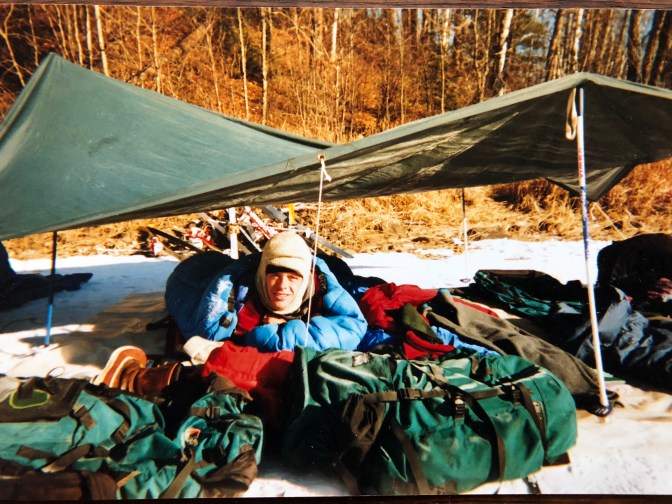
~ Winter camping requires special preparations and knowledge, but can be a delightful adventure — especially with animal companions.
Into the Cold
The first thing I noticed upon stepping out of the car was the lack of snow. Minnesota, particularly Northern Minnesota, should have more snow than this. A few inches at most lay on the ground, but certainly no more. I wondered if the sleds could travel with almost no snow. I had seen wheeled carts that people train their dogs on, but I figured they would probably be difficult to control on the trails. Besides, what if it snowed once we left? It was unlikely carts could travel with much snow on the ground.
The lack of snow certainly had nothing to do with the temperature however. It was well below freezing when we arrived. Ely Minnesota was very, very cold.
First thing, I was issued gear. I stood shivering outside a wooden shack with clouded breath and ringing hands while pieces of equipment were tossed out the door and onto the frozen ground. As I picked them up and crammed them into my backpack, I took particular notice of the things that were going to make camping in a Northwoods winter survivable. One thick synthetic sleeping bag with a down liner, one metal sierra mug, one spoon, a journal, a whistle, and one water bottle. That was it. I expected more. After all, I would be outside, and it was very cold. There was no special-this or emergency-that to keep me warm and safe in the event of a mishap. I routinely carried more than this on summer hikes. This was a dogsleding trip, and I would be traveling over frozen ground and water, in freezing winds. I had just arrived here with five others to be trained as outdoor expedition leaders, and already I was nervous.
After packing our backpacks, the six of us were led to the bank of a frozen river where we crouched in a patch of snow. Here we received a lecture on ice safety. We were given the basics on how to judge the strength of the ice we would be traveling on, and it was explained what would be done should someone plunge through. What a horrid thought. Being immersed in such cold water in this weather was unthinkable. I sat shivering on the bank of the river, and decided that I would concentrate more on prevention than rescue. However, it was then that our instructors called our attention to a hole in the ice in the river that ran before us. It was our first task as a group to decide who would go through that hole in order to practice a rescue.
Our entire group stood silent and ashen faced. I assumed everyone, like myself, was racking their brains for some medical condition that might preclude them from stepping forward. No man could possibly subject himself to such an abominable submersion. One of the women stepped forward.
The rest of us exhaled and smiled, patting her on the back and congratulating her on such selfless bravery and valour. She had volunteered, and there was no way in hell we were going to allow her to back out now.
Four sleeping bags were zipped together so that our victim and a few members of the group could dive inside after her submersion to help keep her body temperature at a safe level. This was how we were to react should this really happen on the expedition. She was given some raggedy old clothes to change into for the purpose of this drill, and with a rope tied around her waist for safety she shuffled out onto the ice. From the shore she looked like a suicidal hobo standing at the edge of a navy blue hole of churning freezing water. Without a sound she closed her eyes, pinched her nose and splashed feet first. The expression on her face surging from beneath the surface of the water remained in my thoughts for the duration of the trip.
Off and Running
There was absolute silence among the dogs standing harnessed, eagerly leaning forward, tugging squarely on the gangline. The sun was just beginning to sink below the pine trees on the horizon of the far side of the lake. Gusting winds swirled snow crystals off the surface of the ice and into my face, which I protected with an upturned collar and a down-turned monkeycap. I stepped onto one of the runners of a sled, an instructor took the other, and muffled through her mask, “hold the bar tightly,” which I did. She leaned down and yanked up the sharp steal anchor that was embedded in the ice and stood up to grasp the bar tightly as well.
“Hike,” was all that was said, and the sled lurched to an instant cruising speed that seemed completely unfettered by the nearly 1 ton cargo the dogs were pulling. Blasting across the ice on the back of a dogsled was altogether exhilarating. The tedium of preparation was behind us, all anticipations assuaged; we were on our way.
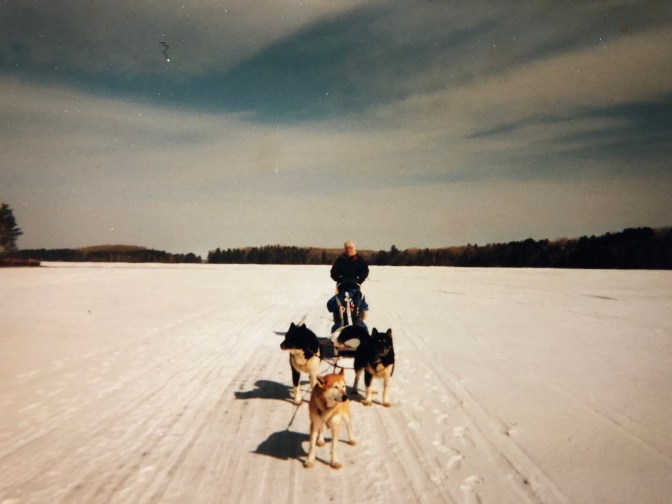
~ Taking a turn at the helm.
However, I was then beginning to realize the dynamics of what was going on. Any appearance that either the instructor or I were in control of the sled was just that, an appearance. The fact was the only ones in control were the dogs. Riding on the rear of the sled, we could merely suggest subtle changes in direction, “gee” for left, “haw” for right. These suggestions were routinely vetoed by the dogs. I also realized that, if I were to somehow fall off the sled while in motion, it would be like falling off of a sailboat in rough and stormy seas. I would have no hope. The speed at which we traveled was far faster than I had anticipated, and any attempt to run and catch up was absurd. I knew I would simply have to hold on, no matter what.
We continued on across the enormous lake, our destination only as far as the other side. With our late start, we had little time before it would be completely dark. Camp had to be made soon. When approaching the far shore, the instructor stepped on a pedal between the two runners that had large metal teeth intended to slow us in the snow. There was no snow, or very little, anyway, and the teeth merely skipped and chipped across the top of the ice, no matter how hard she stomped on it. We were not slowing down, and I could see that she was beginning to reevaluate.
“We are going to have to tip it over!” she shouted over the tremendous scraping of the break on the ice.
She then stepped across to my runner, and told me to lean to the side, which we did, pulling the sled over with a thud, throwing us spinning on our backs across the ice. The resistance was just enough to cause the dogs to stop. We got up, brushed the snow off our clothes and inspected the sled. Everything was still tightly packed and attached.
The other sled thumped and skidded shortly after us. Our first job was to secure the dogs. The dogs were tied up out of each other’s reach, where they each nestled a shelter into the sparse snow. Drifts began to gather around each of them, and before long, they were almost covered. The dogs, outside of their meals, took care of themselves for the night. It seemed that the dogs might keep warmer if they were tied together. However, I was assured that if any of them were to reach each other, pandemonium would invariably ensue. The dogs, though gentle with the drivers, delighted in fighting each other.
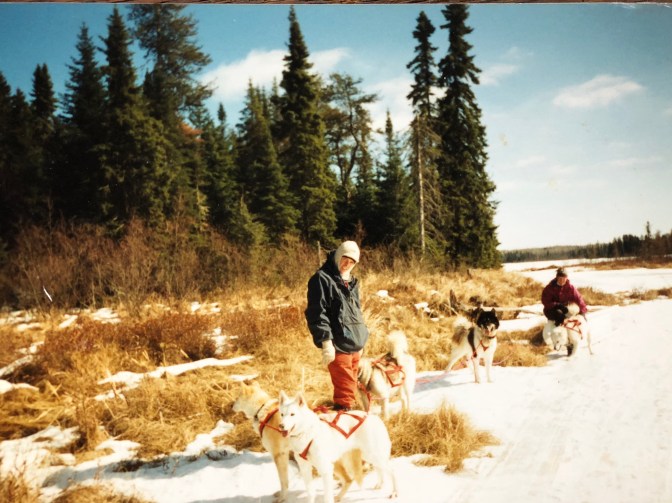
~ Minding the dogs at a pause.
I stood on the ice in the windy darkness and watched the dogs prepare for sleep. Some of them shuffled and squirmed to try and work themselves into the paltry snowdrifts gathering on them. Some of them lay perfectly still except for the contractions of their breaths. All of them curled into balls to stay warm–except one. A dog named Gustaff was pacing quietly and methodically in a circular path that was the outer diameter of the rope to which he was tied, head down, huffing furious clouds of breath. This was not a broken spirit, like the lions that pace mindlessly with vacuous eyes in the zoo. He was pent up, like a coiled spring or a loaded sling-shot. The longer I watched him, the more I realized that what I was seeing was not aggressive or defiant, but pensive. He was probably not even aware that I was standing there. His eyes were fixed on something further away than where I was standing. He was waiting to run.
The humans were already seeing to our own warmth when I left Gustaff. Rather than an igloo, or a tent, we were to sleep under wall-less tarps laying our ground-pads (a sheet of ¼ inch foam) directly on the ice. These, and our sleeping bags, were to be our only shelter. That evening we all climbed into our sleeping bags and joked about bringing the dogs into the bags with us. We all pressed our coccuned bodies together; it was no time to be demure.
Assorted Nightmares
In the middle of the night, we were awoken by a sound something like a large calibre rifle discharging very close to our ears. I sat up, ears ringing, to find everyone else rustling uncomfortably.
“What the hell was that?” I shouted above the bells in my head.
No one knew exactly, though we all had our suspicions. We gently rested our heads back into our sleeping bags, and shivered, mostly from the cold, and fell back to sleep.
The next morning we peeled the foam pads from partially melted indentions in the ice, revealing what we had suspected the night before. There was a fissure in the ice large enough to insert the better part of our arms. A crack exploding with the sound of a sonic boom, right underneath where I slept, made me feel vulnerable.
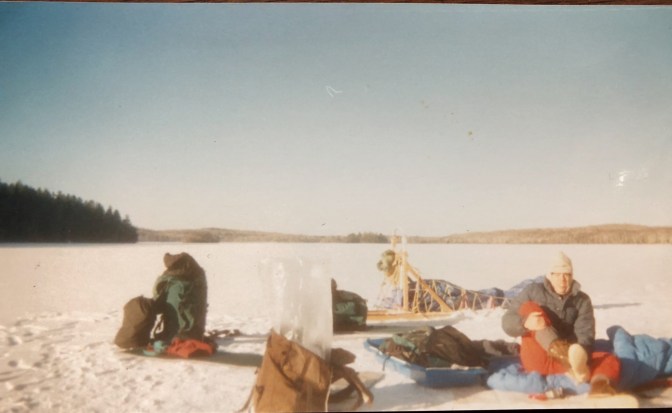
~ Climbing out of my sleeping bag and putting on my boots.
Most of the dangers that we faced on this trip were manageable in the sense that there were certain precautions that could be executed making risk calculateable and foreseeable. Cold was the most likely danger. It acted slowly, and beset upon its victim with ample opportunity for alarum. Cracks in the ice were altogether different. The fact that a hole may open beneath me at any time, and send me crashing beneath the surface where I would be left bobbing against the bottom of an ice sheet, scratching and clawing for a last gasp of air concerned me. We were to spend the duration of our trip on ice, with only short interludes of dry land portages that connected the lakes. I began calculating my odds.
On the Trail
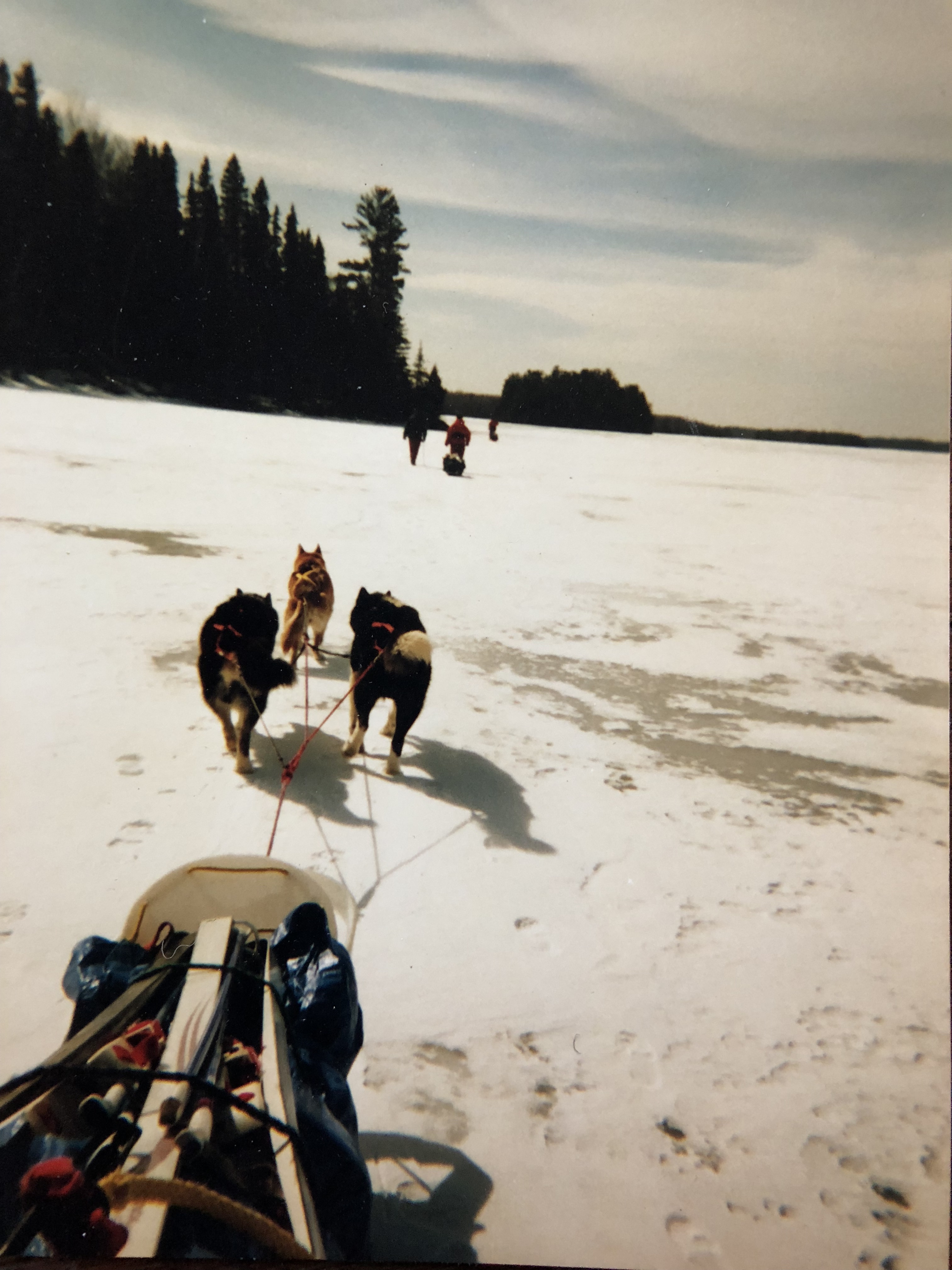
~ A view from the sled.
We loaded our sled and attached the gangline, spreading it out evenly on the ice forward the sled. One by one, we detached each dog from their restraint, and walked them with equally rigid and apprehensive movements to their place on the gangline. Every time we did this, they howled with frenzied impatience. For twenty minutes the tension built as we harnessed each dog, keeping each at tooth’s length. Once all the dogs were attached, we yanked out the ice anchor, and the sled launched forth.
For the first thirty minutes of each morning, the dogs ran a balls-out dash. Then slowly, the edge of morning impatience became blunted by exercise and the team began to settle into a smooth cadence where the patter of their feet on the snow was perfect as a metronome. This was the time the dogs shined. They were then prepared for direction from their drivers. With a simple call to “gee” the dogs in unison arced to the left, and with “haw” they arced to the right.
These moments of synchronicity, however, were constantly punctuated with moments of shear frustration. Quite often, we were forced to halt our progress to check our whereabouts on the map. On the vast windswept openness of frozen lakes, it was easy to wander off course without noticing.
After twenty or thirty minutes of running, we would lean the sled over onto its side, where the two drivers skidded spinning across the ice. After picking ourselves up and removing the snow, we would pull out our map and compass and verify our position. The process was tiresome for both drivers and dogs. The dogs could well run for hours on end without need for rest. These pauses aggravated their impatience, which caused them to vent their frustration on each other. While we hovered over our maps the dogs would exchange verbal threats and nip at each other’s hinds.
At one stop, I watched Gustaff make a clever move to vent his own frustration. From his rear position on the gangline, he took the rope that ran ahead of him in his mouth and tugged it, pulling a lead dog toward him. Every time he did this, the lead dog would scratch and paw at the snow, attempting to keep her distance.
With each stop, the unrest became more pronounced, until finally, while we stood on the center of an ice sheet making sense of our maps, the entire gangline exploded into a fury of yelping and biting.
Once the dogs begin to fight, tremendous care must be used when attempting to separate them. The animals take such fiendish delight in fighting they are liable to bite anything within reach. Beastly growls, pained yelps, and a writhing furry mass tangled itself into a snarl of rope within the gangline. Legs and tails were bound within, dogs were wrapped tightly and nervously against one another, panting and licking their wounds. Two dogs were tangled face to face, and kept a tense look at each other out of the corner of their eyes.
Separating them was something like defusing a bomb. Wading into the mess, standing amongst the entangled team, nervously untying each member, we had a feeling that one misinterpreted movement might ignite another frenzy of barking and biting. Gingerly we worked, untying each dog and reassembling the gangline, breathing easier with the isolation of each provocateur.
In the summertime people paddle the approximately 10,000 lakes of Northern Minnesota in canoes and kayaks. Between most lakes there are short trails called portages that allow a person to make the generally short walk to the next lake. Using these portages, a person can hop from lake to lake traveling for literally thousands of miles.
Our intention was to guide the dogs in the general direction of where these portages began on the bank of a lake. As we approached, the team would hopefully see the trail, and steam right on through. The sled skidded off the smooth surface of the ice and thumped onto the rough uneven ground of the portage. These portages provided interludes of exciting winding trails that wove narrowly between Cedar and Ashe trees. To keep the sled from flipping and spilling us off, we had to lean into the turns, stepping from one runner to the other. The dogs would move tremendously fast, having no regard for what we were going through at the rear, struggling to keep the sled upright. On tight turns the sled swung to the outside, and many times the runners banged the trunks of trees. All this while constantly ducking branches that threatened to swat us off.
The forest opened back up eventually and we would be cruising back down the bank of another lake. On one such occasion, bumping back onto the slippery lake surface, the inertia of the one-ton sled carried us faster than the dogs were running. The affect was the sled skidded in a jack-knife fashion along side the running team. The dogs turned their heads, surprised as us to see the position of the sled. However, only the drivers knew what was coming next. Inevitably the gangline “cracked the whip”, and jerking violently, the sled threw me to the ice. True to my pledge I held on anyway, and lay dragging behind. The team, excited by the event, showed no indication of stopping. The instructor had been thrown off completely and I had no idea how I was going to pull myself back onto the sled. Snow was being forced into every opening in my clothing and my mittened hands could not hold long. The futility of clinging to the sled became obvious, so I let go. When I sat up, I saw the team growing smaller on the horizon. In the other direction, the instructor was sitting inspecting a bruise she had received from falling on the knife case she wore on her belt.
The other sled on our expedition was running far ahead of us and the drivers would have no idea what had just happened. We had hope, but only one choice: to follow the faint trail of the sled in the intermittent shallow patches of snow. We looked down at their paw prints, sighed, and began shuffling in the direction of the dogs.
In our walk, we both noticed the sun was on the downward slope. We said nothing. We did not even raise our heads. We just kept shuffling while the trees continued to stretch longer shadows across the ice. Neither of us felt compelled to quicken the steps of our heavy boots.
In our silent walk it occurred to me that I no longer padded every step on the ice as if I were walking on eggshells. I hardly noticed the air growing colder in the dimming afternoon. Our dog team deserted us along with our equipment and our food, but I didn’t feel vulnerable. Maybe it was my anger with the dogs, but for the first time I was completely at ease on the ice.
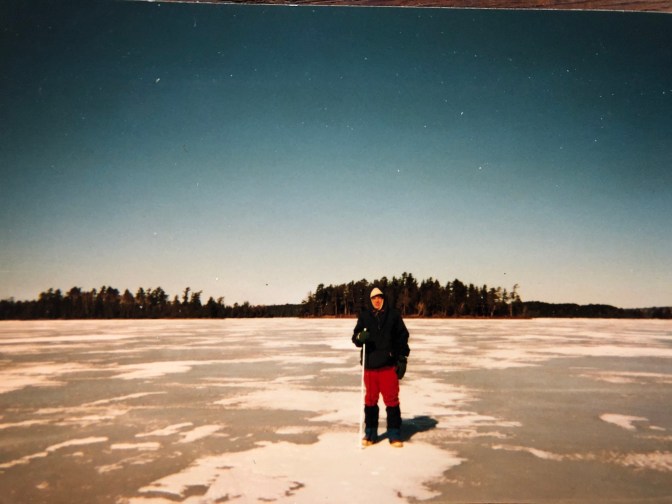
~ Standing on the US / Canadian border, in search of our sled.
After two hours of walking, we could see our sled and team in the distance. The dogs had run themselves into a cul-de-sac on the lake where no portage existed to carry them further. Shuffling closer, we could see the dogs were again wrapped and tangled in their gangline, evidence that they had taken the opportunity for another donny-brook. After two hours of searching for these dogs, the last thing we wanted to do was detangle the god-damned gangline, and we, with exasperated and profane shouts, pulled them apart. This time it was the dogs who moved gingerly.
The ice was here, the ice was there,
The ice was all around;
It cracked and growled, and roared and howled,
Like noises in a swound
~S. T. Coleridge


