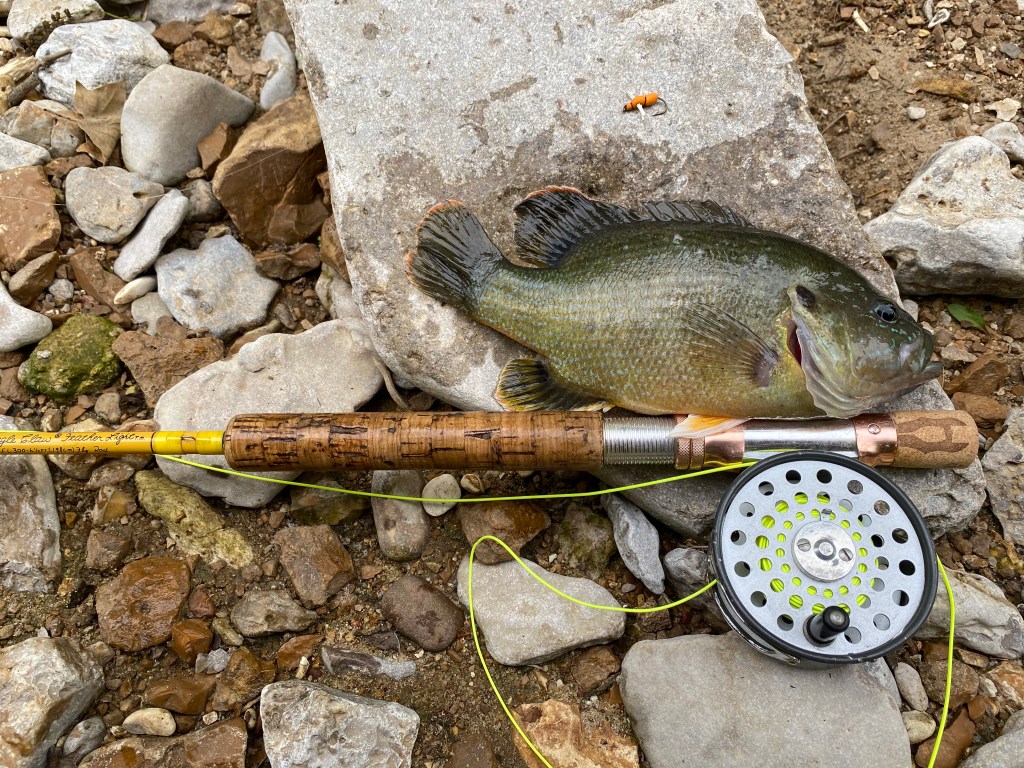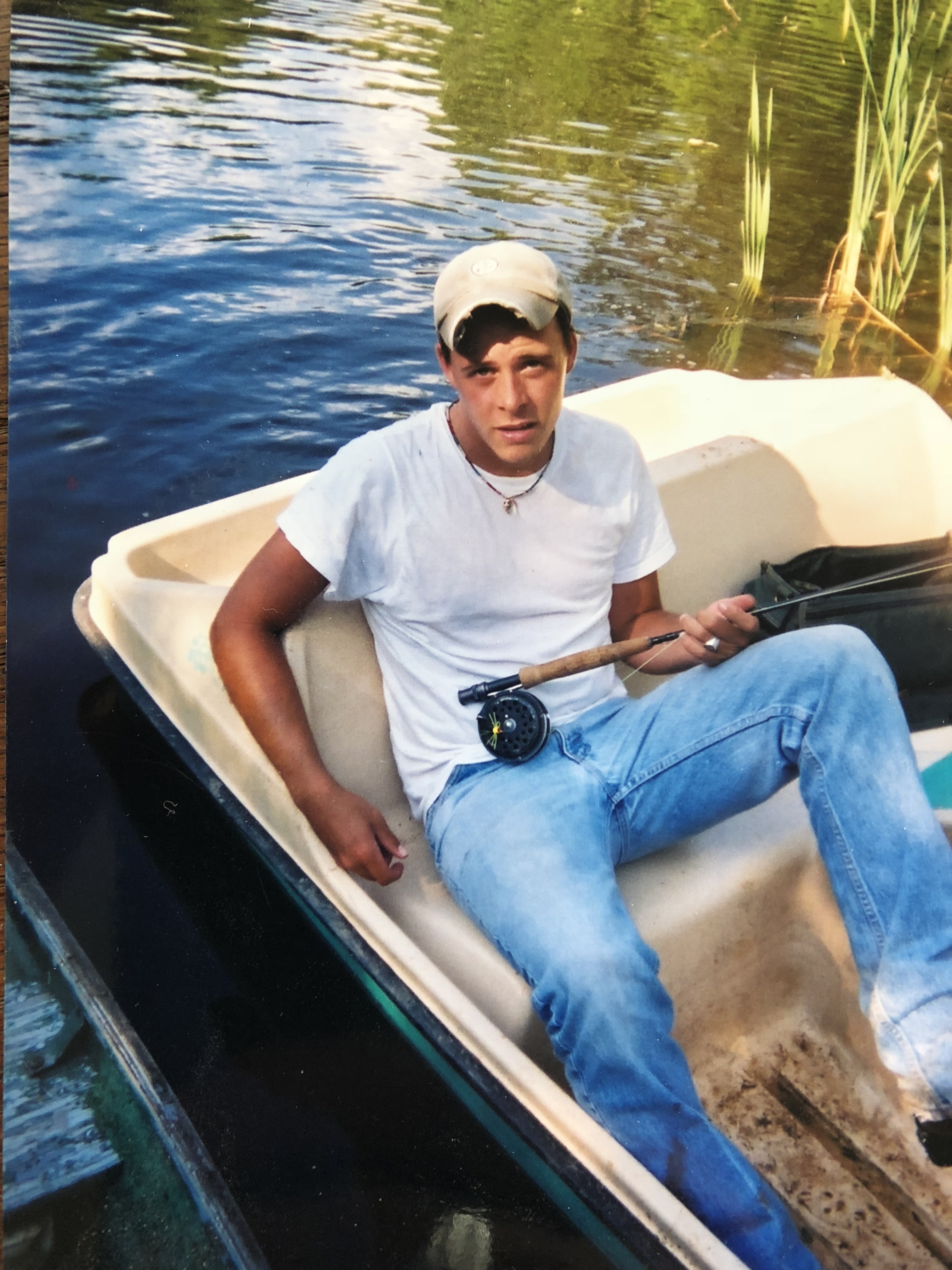
~ Few things have held my attention quite so long as the casting of a fly rod.
First Lesson
Without question, the most popular sport in the United States, in terms of participation, is fishing. However, I am uncertain as to whether all fishing can provide the Zen experience I described in my previous submission. I do not mean to exclude specifically subsistence or commercial fishing here, as I strongly suspect the Zen experience is quite possible in those conditions. Rather, it is two hundred horsepower bass boats or overcrowded public piers or the competitive fishing tournaments that do not seem conducive to a quieted mind. Fly-fishing, on the other hand, is the sport of the gentler gentleman; its foundational properties of balance, rhythm, and mental focus are certainly the components of a Zen experience. I was lucky to discover this by accident.
Some years ago while rummaging for treasures and antiquities in the attic of my parent’s home, I uncovered a small collection of split-cane bamboo fly-rods. For the uninitiated, a cane fly-rod is to fishing what a Stradivarius is to a Mendelssohn’s Violin Concerto. Though I was mostly unfamiliar with the sport, it was the possible value that sent me to a local fly-fishing shop.
I traveled a short distance to a shop that I had always noticed for the classic Land Rovers and International Scouts commonly parked out front with large fly-rod tubes strapped to roof-racks. Inside, the place seemed as much museum as retail with low light, priceless displays of artifacts, and hushed atmosphere. Everything was of a sort of dignified masculine beauty–dark oiled woods, polished silver, and delicately tarnished brasses. On the walls hung mounted fish, retired wicker creels, and black and-white photos of victorious day’s catches. Quite literally there was a pot-belly stove surrounded by wooden chairs filled with old men telling old stories of fish that may have existed. As I entered one of the men stood and moved to the glass counter. It contained displays of tackle that did not just seem to be, but were in fact true pieces of art, crafted by the hands of caring masters and conscientious artisans. Before I said a word to him, he furrowed his brow to drop automatically his glasses from his forehead to his eyes. He squinted towards the fly-rods that I had bundled in my under my arms. I handed them over and told him of how I found them and wondered about them.
“Are they valuable?” I asked the man with Roadshow anticipation.
“Somewhat,” he replied without expression. I should have guessed that the proprietor of a shop like this would be a cool customer towards an obvious greenhorn like me. He knew what I wanted to know, but he was going to force me to ask specifically about money, and so I did.
“Do you think much? One hundred dollars, maybe?” I offered.
“Hard to say,” he replied again coolly. His stoicism was unnerving. Was I so much an outsider to these salty dogs that he could not share or do business with me? Maybe I had walked into a club in which I was not a member—and he was trying to make it clear. Though, here I was, with something admittedly valuable and something that I was clearly trying to sell. Why would he not make a clear offer—even something that would begin our haggling?
“Too valuable to use for fishing?” I then asked, abandoning any hope of quantification.
“Not at all.” He said, finally with expression. “You could do quite well with these.”
His sudden warmth and interest inspired me and I began inspecting the rods a little more closely, “What do you suspect I would need to get started then–to use them for fishing?”
The man finally animated himself and ducked behind the counter to gather things. He popped up with full hands and placed on the counter two small spools, a box of flies, and a few extra odds and ends. “Besides this, you just need to get a reel and you are set to go.”
“What do you suggest?” I asked while continuing to look at the rods that were, at that moment, becoming less the windfall I had anticipated and more of the money-pit I feared. “It seems like an antique reel would go best with these old rods,” and before I could swallow my words I looked around at the price tags on the displays that, in clear and bold handwriting, showed numbers that were for gentleman of means beyond my own.
One of the wood-stove old-timers stood and reached into his pocket and pulled out a reel that looked old, a little worn, and perfectly suited for what I had. It was classy but not pretty—unadorned and all business. Its patina expressed the many fish it had caught, and the many more it wished to catch. “It’s an old Pflueger,” he said, “fits those old cane rods you have.”
I suspected that these guys waited for greenhorns like me to blunder in and unwittingly pay top dollar for their tackle. He probably had me pegged when I walked through the door. All of them are in on it, I thought. We’ve got just the thing for him–they must be thinking. I might as well ask … “How much would you like for this?” I cringed, wondering — one hundred, two hundred, more?
“Fifteen bucks, I guess. You think you can do that? It’s got a little boat rash, but works just the same.”
I set down the rods and picked up the reel, looking closely at it, “Sure I can. How much for the rest of this stuff?”
The man behind the counter mumbled numbers and shuffled through the stuff on the counter and explained this was out-of-date and that was something on clearance and then offered it all for thirty. This I accepted gladly.
I gathered up the new accoutrements that were now evidence that I was indeed a fly fisherman. I stood a little more at-ease. I now held the fly-rods with conviction — by the handle and occasionally shaking them to inspect their flexibility. I even held one up the light to peer down the eyelets to inspect it for flaws.
One of the still seated men asked me as I began to turn towards the door, “Where do you plan to use that stuff?”
“X* Creek. I think there is a fair number of trout in that stream,” I said with a casually authoritative tone.
The man behind the counter broke in immediately, and with a tone of concern, “There are no fish in that creek.”
“Sure there are,” I said in stunned protest. Why, I should know, “I’ve fished that creek since I was a kid.” I may not have known much about this tackle, but I knew damned well that that creek had trout in it.
“There are no fish in that creek,” he repeated with increased emphasis and volume.
When my facial expression did not register understanding they, the man at the stove chuckled and winked and I understood that I had just received my first lesson in fly fishing.
*Please note that the name of this creek has been withheld in deference to the master fisherman whom I met in the shop.
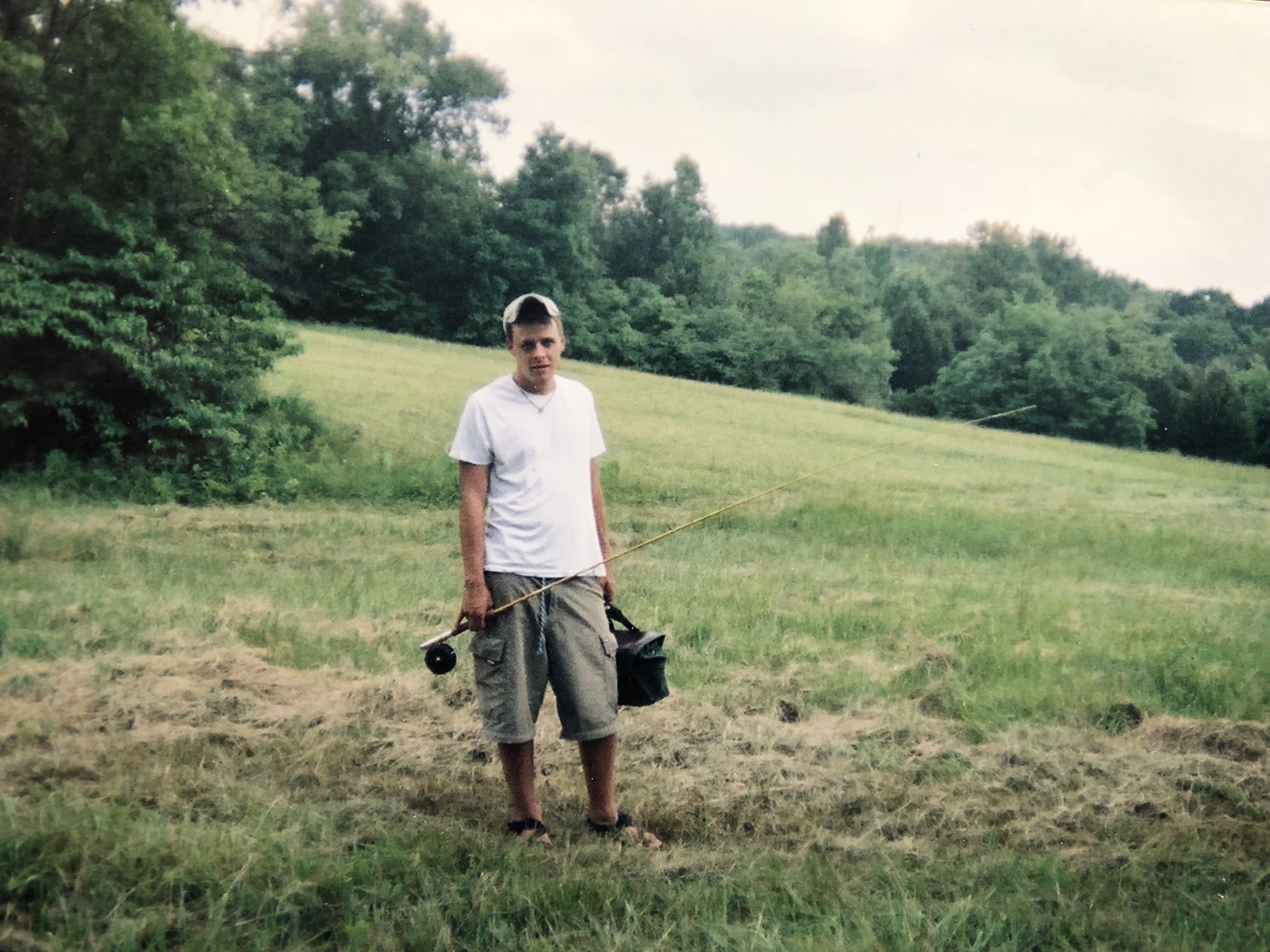
~ The streams of the Ozark Hills were my introduction to fly fishing.
Second Lesson
In my previous submission, I learned that it is not enough for a gentleman to simply own fine sporting equipment. Furthermore, it is not at all acceptable to seek profit from it. Instead, a gentleman should learn to use that equipment and seek the physical and spiritual benefits they might provide. I now owned a set of split-cane bamboo fly rods and all the necessary accoutrements, which was proof enough that I was now a fly-fisherman. It was time to venture afield. Unfortunately, there were no appropriately wild trout streams in my vicinity — the sort Norman Maclean described in his stories about fishing in Montana. And so, instead, I packed up my fishing things in an old-fashioned canvas rucksack and took a very short trip to a local public pond near my neighborhood. This local pond is a rather suburban affair — a near perfect circle with concrete banks around much of it and a picnicking pier that reaches out toward the center. Spaced evenly along the banks were bait-fisherman sitting on their coolers and watching their bobbers.
Bait-fisherman are a different sort than fly-fisherman as their sport is more passive. Instead of elaborately hand-crafted flies, they use worms, grubs, or some-such-bait on a hook. Instead of the constant rhythmic casting, they toss their bobber and bait into the water and wait. Sure I’d once been a bait-fisherman, but as I passed them one by one sitting along the bank, the technique seemed very boring to me. I walked around a bit before I found a space big enough to allow me to safely cast without hooking someone’s hat or earlobe. I placed my rucksack near the edge of the pond and ceremoniously, with great flourish, pieced together one of the rods, then attached the reel, and finally strung the heavy fly-line through each of the eyelets. The most exciting part of the procedure was tying on the fly (the lightweight lure with a hook in it) to the end of the “tippet” (the very thin line attached at the end of the fly-line). I had spent significant time learning the appropriate knot for this as I wanted to be certain not to lose my first catch to ineptitude.
Fly-line is designed to have greater mass than normal fishing line, so that it can be flung through the air as one whips the tip of the fly-rod to-and-fro. It is the weight of this line, and not the weight of the lure, that propels the lure. I raised and then thrust the tip of my fly-rod forward, and then backward, and then forward again letting out line a little bit at a time. My early casts were not at all disappointing. In fact, after only a few tries, I was able to fling the heavy line nearly 25 feet. I did this repeatedly, casting it out, then reeling it in. It did not matter that I was not catching anything. I was having a very good time whipping the line around and watching it cast out over the pond and then splash into the water. What’s more, I noticed that I was being watched occasionally by one of the nearby bait-fisherman. I was certain that I was putting on quite a show for him and became delighted when he walked toward me to speak. We greeted one another and he asked if he could take a look at my tackle.
“Split-cane bamboo!” I said, before handing over my fly-rod. I must have been a curious sight for him, I thought. Such a different sort of sportsman with my obtrusive casting and odd tackle. It would be my pleasure to assist in his curiosity.
“Yes it is,” he said, shaking the rod to test flexibility — as I had done in the fly-shop a few days prior. “Do you mind if I try this?”
“Not at all,” I said proudly, and gave him a short lecture about what techniques I had found to be successful. He listened and smiled with rapt attention. When I finished, he motioned to the water and I stepped back to give him room.
He raised the tip of the fly-rod with some authority, and upon doing so, entered into a sort of Zen-like trance. With great precision of motion and meter he began waiving the the rod to-and-fro, and at the same time, feet upon feet of fly-line began expelling itself from the eyelet on the tip of the rod until the line reached seventy or eighty feet out over the pond, landing gently upon the surface of the water. He snickered a bit—not smugly, but seemingly from embarrassment — and he reeled up the line and tried again. His second attempt was more grandiose in motion and eloquent in style and the line flew from the eyelet at the tip of the rod even more furiously reaching out well beyond one hundred feet, and again gently coming to rest on the surface.
I was transfixed. “How do you do that?” I asked, and so began a true lesson in casting. That evening I learned to back-cast, roll-cast, and “present” the lure to the surface of the water gently so as not to scare the fish. Above all, I learned how little I knew. Finally, when we were packing up for the evening, I asked him, “Why don’t you fish with a fly-rod in this pond?”
“There are no fish in this pond that bite on flies,” he said politely and left.
The Young Man and the Stream
Not long after my second lesson in fly-fishing, I graduated from the suburban pond I mentioned in my previous submission. I began fishing some of the wilder, more pristine streams of the Ozark hills. With constant practice, my casting became proficient, and my ability to secure quarry improved as well. On weekday evenings, I stood out in a grassy field near my home and practiced the accuracy and distance of my cast, and on the weekends I packed my rucksack and ventured into steep Ozark valleys where I waded into clear and cold streams and caught dozens of small-mouth bass, hundreds of bluegill, and the very occasional and welcome trout. At night, I camped along the banks of streams, sleeping in the back of my Subaru wagon. In the mornings, I packed a small lunch of two boiled eggs and a crusty scone and waded out into the cold running water, constantly casting and walking slowly waist-deep against the current. On warm days I wore only sandals and shorts with my small rucksack on my bare shoulders. On cooler days I wore hip-waders, which kept me warm enough to fish well into the winter months. I spent hours learning the deep green holes where the larger fish waited in still water, or the eddies where they rested in an upstream current waiting for food to drift by. I also found that fish hunted under the large branches of old trees hoping for a bug to fall to the surface of the water. Sometimes that bug was the fly on the end of my line. With the hours of solitary wading and exploration, I gained a special familiarity with the streams and they began to feel like my own. It is strange then, that it was during these weekend meditations that I decided that I should move east to the Appalachian Mountains.
The reasons for my move were many, but access to world class trout streams that seemed to run every valley of western North Carolina was significant. In fact, I selected the location of my home — south of the city of Asheville — specifically for its proximity to those streams. Out my front door, within a very short walk, was the French Broad River, and out my back door, within a short drive, were smaller trout streams so numerous that most had no names. Only in a lifetime could I hope to fish and explore each of those streams.
When I arrived, I unpacked my things into a small apartment and looked forward to the official opening of trout season.
Opening morning I awoke before dawn and drove into the valley of one of Western North Carolina’s fairest streams. It also was likely the most popular. By the time the sky began to show dim light on the valley road that skirted the riffling water, I could see dozens of cars and their roof-top fly-rod-tubes double parked and squeezed into improbable and outright dangerous spots. I was sure that a car had one of its four wheels dangling over the steep bank of the stream so that it was just out of the driving lane. The four wheel drive of my Subaru ensured that my own parking spot was no less asinine. I popped the hatch to the rear of my car and gathered my things. A small aluminum fly-box with little delicate glass doors that compartmentalized each precious fly, a wooden fishnet with lanyard, big footed waterproof waders, my fly-rod, and finally my newest and most precious artifact: a creel made of woven wicker. I shut the hatch and walked through the morning fog and shivered from the damp cool air and the understanding that I was now big time. Was this how Yo-Yo Ma felt when, for the first time, he dragged his cello on stage at Julliard? Never mind that, I knew that I was now prepared. Much of my confidence was placed in the outfit that I had carefully chosen for that morning — gray woolen Woolrich pants with thick suspenders, heavy plaid shirt, vest with innumerable pockets, bucket hat tilted rakishly to the side, and wicker creel slung over my shoulder. Perhaps my appearance was a bit kitschy. Perhaps I was overcompensating. Perhaps I was a little over the top even for Mayberry R.F.D. But a gentleman should dress for the occasion.
I carefully stepped down the slippery, muddy bank into the fast flowing water. The roar of the rapids was more than what I was used to on the gentler streams back in the Midwest. The whole scene seemed wild and more dangerous, except for the half-dozen or so people who were also preparing to cast in my immediate vicinity. Actually, one of those people was not preparing to cast, and wasn’t there to fish at all. He was dressed in blue jeans with no waders, a red baseball cap, and a camera that hung around his neck. Standing in the middle of the rushing water, while I was enjoying the ceremony of tying my fly to my tippet, I saw this man waiving to me in my peripheral vision. I finished my knot and looked up and saw that we was looking and motioning to me directly. I was only fifty or so feet away from him, but the roar of the water made it impossible to communicate, and so I carefully pushed my legs through the current back to the bank where the man in the red hat greeted my enthusiastically.
“Why look at you!” he said to me, as if I might know him and recognize him. “You look like you are prepared for the day.”
“I am ready to fish, alright.” I replied.
He explained that he was from the newspaper, and they were planning to do a small story on the opening day of trout season. “You look just the part,” he said with the sort of chuckle that was difficult to identify; with me, or at me? — I wondered. “Do you mind if I snap your photo?”
No matter, I thought, I was to be in the newspaper. “Of course not.”
“Just go ahead and fish as you normally would. I’ll take your photo from here.”
I pushed my way back out through the rapids, into the middle of the stream. I pulled some line loose from the reel and prepared to cast and I noticed that my hands were slightly trembling. I found myself acutely aware of every movement that I made. No longer was my practiced motion of casting second nature or muscle memory. No longer was I on my own, free to fish as I may in the secluded stretches of my own Midwestern streams. This man, with his red cap, and his camera pointed at me broke the meditative state that was so essential to my casting. I raised my arm to cast, and flicked the tip of the rod forward, and then backward, and then I felt a terrible resistance and looked back to see that my fly was tangled in the branch of a tree. My heart sank, and I tugged at it and prayed that it would free itself and I tugged harder and I cursed, and then tried whipping waves through the line so that it might untangle itself in some improbable way. The fly was clearly in that branch for good. I grumbled and cursed and tugged harder until, inevitably, the line broke with a snap. I took the aluminum fly-box from my pocket and opened a glass door to pull out a fly with hands that were now shaking beyond control. I began tying the fly to my tippet and dropped it into the water. It disappeared in an instant. I pulled out one more fly from my box and tied it on with a secure knot, this time, and I reeled up my line and began my second cast. I also noticed that the newspaperman had slipped away quietly out of sight.
Later that afternoon, while sitting on the bank of the stream, eating my hard-boiled eggs and crusty scone, I watched the other fishermen and women pack up their things and slide their fly-rods into the tubes atop their cars and pull out from their improbable parking spots and leave. Good riddance, I thought as each one drove away. Later that afternoon the air was warm — maybe too warm to fish, but I had the stream to myself and I explored the deep green holes, the eddies, and the overhanging branches.
A Fish in the Hand …
My opportunities for fishing in the Appalachians were many. On days that I wasn’t working, I was out in the hills looking for new streams I had not yet fished. On days that I did work, I rushed home after my shift so as not to waste a moment of the afternoon sunlight. I did not have to venture far—at the end of the road on which I lived was one of the finest smallmouth bass streams in North Carolina. It was a stream that attracted anglers from all over the country. With such short proximity I quickly became a master of its waters. I knew all of the deeper holes, the eddies, and the overhanging branches that dropped insects to the surface of the water where fish lay in wait. Eventually however, it became, to me, rather commonplace. It was the stream I fished when I had no time to explore another.
I should pause for a moment and explain—upon reflection, the word explore is more apt than fishing, as that was really what I was doing. Truth told, I was not a very effective angler. For all the time I spent hiking along muddy banks, wading into streams, and casting my line, I caught very few fish. I cannot say why, actually. Maybe it was that I did not keep my line wet, or in other words, I was a compulsive caster, more interested in the Zen of a perfect cast rather than landing a fish. Nevertheless, I had a wonderful time, fish or no.
On one such day, I rushed home after work, I reached the front door of my apartment and began pulling and pitching my work-clothes, grabbing my jeans and wool shirt, waders, fly-rod, and box of flies. The creel stayed put—even if I caught one, I had no interest in keeping it. Twenty or thirty seconds after entering the apartment, I exited.
Sometimes I walked the short distance to the river, but typically due to waning light and waxing eagerness to fish, I drove to the stream—as I did in this case. There was a small dirt parking lot for anglers and boaters where I sat on the tailgate of my car, pulled on my waders, and sorted my accoutrements.
From the lot, I walked a narrow path, pushing through the burly bushes along the banks of the water until the stream was before me. It is an uncommon stream in that it was very wide—maybe 120ft. across. The depth was relatively constant from bank-to-bank—rarely exceeding three or four feet. Wading this stream was tricky however. Rather than mud or gravel, it was full of large stones and boulders, making the bottom severely uneven and difficult to negotiate in the swift current.
The time was mid-afternoon, and the trees were casting long shadows across the water. The leaves were just beginning to show hints of fall colors and the breeze brought a new chill that hinted at the coming season.
The brushy banks and uncommon width of the stream meant that to fish it properly, one must wade out into the swift rapids. I stepped down the steep bank into the water holding firmly the bank, searching for secure footing, then letting go. I traversed to midstream carefully, leaning against the current and stepping deliberately, moving slowly. I thought carefully about each step, making sure not to allow a foot to become wedged or trapped between two stones, at the same time avoiding deep holes that may send me suddenly swimming. The current and waves roiled against my legs and gave the tops of my waders only about two inches freeboard. Occasionally a splash of cold water overtopped and gave me a chill.
Finding a good place to stand, I planted my feet and began my preparations. I tucked my fly-rod beneath my arm and pulled out my fly box. Traditional flies would not due for smallmouth, so I looked to my poppers and Sneaky Petes. I faced downstream as I tied on my popper, bracing against the strong current.
In this river, eddies abound because of the many boulders that project from the stream’s surface. Fish lurk within the steady-eddies, allowing them to rest and wait for food to flow by.
By this time in my life, my casting had become as natural as breathing. I lifted my rod-tip and found myself in that Zen-like place where conscious thinking was no longer necessary and meditation and muscle memory were all that I needed. I brought the rod back and forth and began to expel line and looked around for a place to land my popper. I spotted a nice eddy not very far away where a glassy-still pool of water was surrounded by ripples. My popper landed gently and directly in the center of that pool and the surface of the water bulged and splashed with the rise of a fish. My fly line went instantly taught. My hands trembled from the rarity of this excitement and I drew in the line until I could reach down and lift the fish from the water.
I gripped the fish by his lower lip and held it up in front of me. There was no one to admire it but me. A welcome change, I thought. I rested the fish gently into the water and adjusted my line to begin casting again. In just a few more casts the surface of the water bulged again and a fish splashed and tugged the line and I drew it in and lifted it by the lip. The luck of it! I was on to something—was it the barometer? The changing season? I could only guess. From where I stood, I continued to search for eddies, and cast my line, and catch fish until I exhausted most of the eddies that were within reach of my line. It was one of those rare days that I knew—during that moment—that I would never forget it. Golfers have their six-under par, pitchers have their shut-outs, bowlers have their three-hundred pins. I had this day.
I looked for more places to cast my line, so I turned upstream. I spotted a larger eddy some distance away. Larger eddies have larger fish, I reasoned. Casting upstream is generally more difficult, and this spot was toward the limit of my range. I did not want to risk losing my firm footing and began to try for it where I stood. I wanted the fish that lurked within that eddy. I craved it. I knew I could have it, today of all days. I need only reach it. I brought my arm back and forth in wide casting motions, expelling huge amounts of line, then hurling it out ahead of me. It fell short. I began to think, and to concentrate, and to reason—I could reach that eddy, I need only figure out how to cast a bit further. So I became conscious of the motion of my arm making broader and broader motions and I thought some more and began to rock my upper-body in an unnatural motion to add just a bit more power into my cast. My body teetered, my arms flailed, and I splashed backwards into the current and my head was beneath the water. The cold water shocked me but I could not gasp and my body thrashed involuntarily. I wanted only to get my face to the surface. In time I cannot determine, my head finally crested the water and I was again breathing while I drifted with the current. It wasn’t too far until I drifted near the bank and I grasped it and climbed up. There, on that bank, I sat for a short while, shivering, dripping with cold river water. I looked at the fly-rod that I managed to keep in my hand during all of that. Then I looked out over the water and the eddies and the fish that lurked within them and tried to remember what brought me out here in the first place.