
One hundred years ago April tenth, the most famous of cruise liners left port for her only voyage, which lasted four days and one interminable night. I need not discuss the details of the RMS Titanic, or its tragic fate — her story, and the stories of her passengers and crew are familiar to us all.
Our collective fascination with the night to remember seems boundless. And as the anniversary of that terrible night has approached, I have noted and been curious by the many affairs organized to commemorate the souls who sadly perished, or lived on with the disaster marked indelibly on their consciousness—a 3D re-release of a Hollywood film, countless historical books, benefit dinners, and a play on the legitimate stage. By the way, I do not recommend seeing the play “Titanic,” unless you have thoroughly reviewed the playbill and prepared yourself.
I was, however, surprised by the tone of a recent article written about one of these commemorative events. The author commonly critiques food and restaurants, but in this case has taken to criticizing a pastime. She seems irritated by people who participate in living history reenactments. Take a moment to read it for yourself:: click here.
As I read the article for myself, I wondered–would she share the same criticism of people who go to a play and enjoy watching characters play out such roles on stage? And would the actors on stage be similarly considered ghoulish? Likely no. However, if everyday people (not actors I mean) decide instead to be part of the scene, and share in the spectacle, we are to view this as somehow inappropriate. For the author of this article, there is a line between the drama of the stage and the drama of living history that invites snark towards the latter. I wonder why, as the line is not very clear to me. I sometimes wonder if people handle living history buffs a little roughly because participants tend towards the harmlessly nerdy.
I am not a living historian or history reenactor, though I have met many people who are. I have found them to be personable and compassionate people who do what they do not to revel in the tragedies of history, but instead to preserve and respect the memory of those who lived that history.
This article has caused me to reflect on a weekend that I spent with a fascinating bunch of historical reenactors who portrayed the era of World War II. I look forward to sharing with you those unique experiences.
* * * * *
Some years back I read about the world of historical reenacting in the worthwhile book Confederates in the Attic, by Tony Horwitz. It was a vivid book that followed the passions of a Civil War reenactor and historian named Robert Lee Hodge. Shortly after its publication, the book received a great deal of attention, winning prestigious awards and earning its way onto the university reading list at UNC. It piqued my interest and I always wondered what it would be like to witness such a thing.
There are some things that simply must be observed for oneself—those things about which hearing or reading simply won’t do. Several years after reading the book, I decided finally that I must see a living history encampment for myself. There is one that is held every spring near my home—one that commemorates the soldiers of WWII.
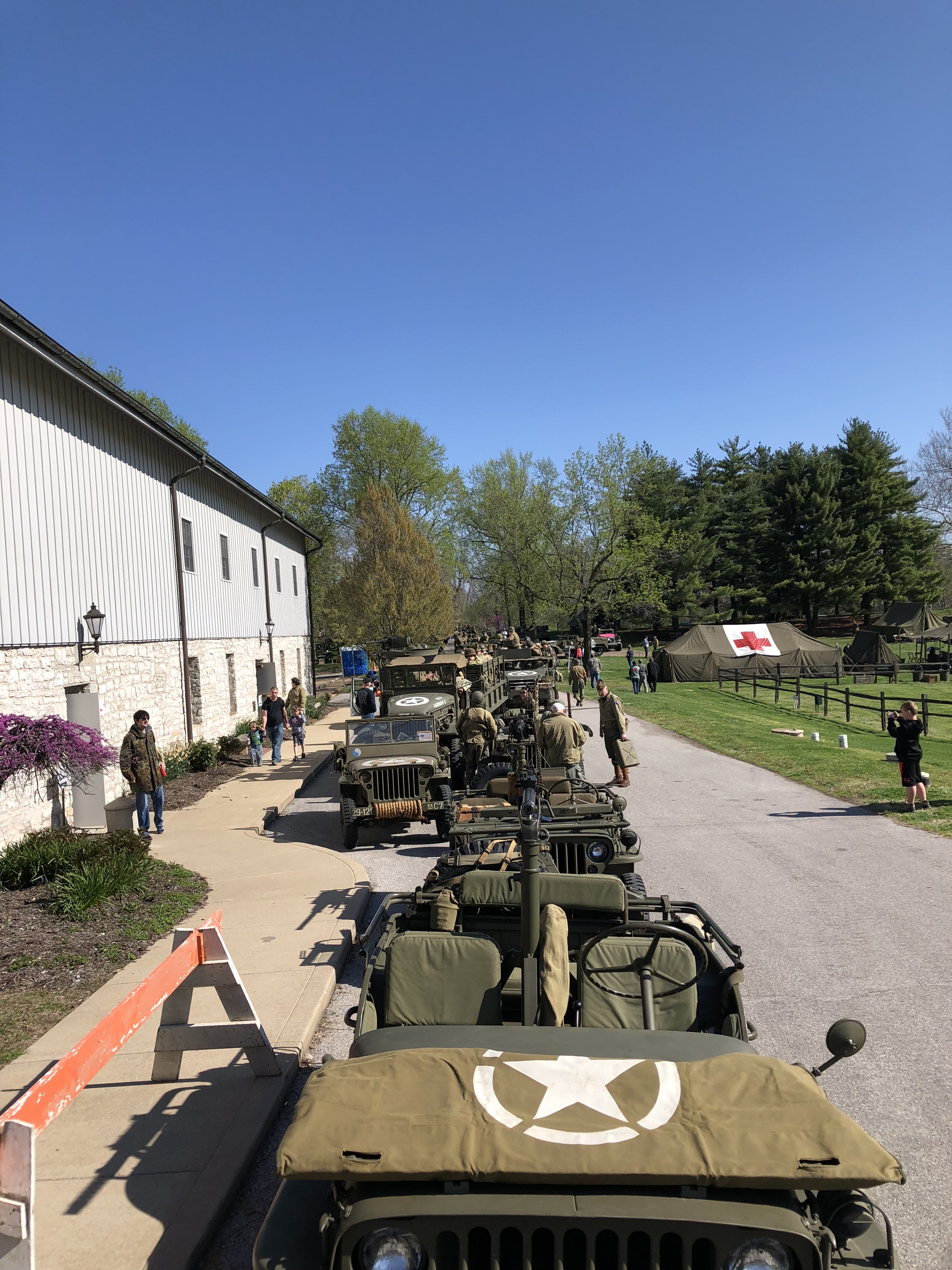
It was mid morning by the time I reached the county park in which the redux war would be staged. Large crowds were already gathered and so I parked my vehicle in a lot some distance from the hostilities. The only way to approach was on foot, and so I walked a plain looking paved sidewalk and noticed that, as I neared the base camp, the density of vehicles shifted from Honda Accords and Ford Explorers to olive drab Willy’s Jeeps and camouflaged halftracks. I also began to see comparatively fewer park goers in white sneakers and bright fleece jackets, and more scruffy looking helmeted soldiers with grimy tunics and heavy rifles slung over their shoulders. On short, crooked posts hung hand-painted signs that pointed to Berlin this way, Paris that way. Rolls of barbed wire uncoiled to cordon off areas of ammunition crates, pup tents, and and make-shift canteens. As I crested a small hill at the edge of the camp, I looked down into a shallow valley. A world of 1944 lay before me. Tanks and trucks of various design were lined up neatly in a motor-pool area. Artillery pieces pointed their barrels skyward. Sand-bagged machine gun nests were scattered throughout the perimeter. Uniformed soldiers were everywhere. Some soldiers marched in small columns, others milled about futzing with historical artifacts.
Standing on this small hill, I could see that the base camp was, if anything, quite orderly. Tents were lined up in perfect linear order. Equipment was stacked and stowed neatly. I could discern sectors of different national origin and one clear dividing line. To one side lay axis troops, to the other the allies, and between the two, only a small footpath about four feet wide. Each nation’s encampment was made of tents of different shape and color—some dark green, others mustard yellow, a few splotchy camouflage. To make clear their allegiances, each grouping of tents flew a flag.
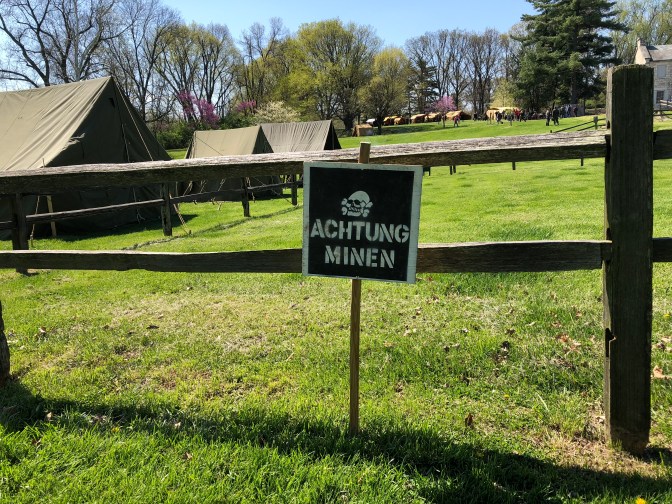
If there was anything disconcerting about the scene, it was the general peace between the soldiers of belligerent nations. I was immediately struck by fraternization shared between a group of American soldiers who were admiring the weapons of a group of Germans. They passed their rifles back and forth and chatted and laughed and wandered off together talking as old friends. From a distance I watched them, waiting for one group to get the drop on the other and take prisoners or mow down their enemies. They just continued talking and laughing.
The camp was what living historians call a static display—and with few exceptions, it was entirely open to the public. People are encouraged to wander around, ask questions, and inspect the historical materials. I began a short walking tour of the displays.
The troops whose presence was most numerous was by far the Americans. They were everywhere and their camp was sprawling with dozens of pup tents, officer’s tents, supply tents, and even a surgical tent that displayed an operating theatre including all the medical accoutrements. The American encampment lacked no necessity, nor any luxury.
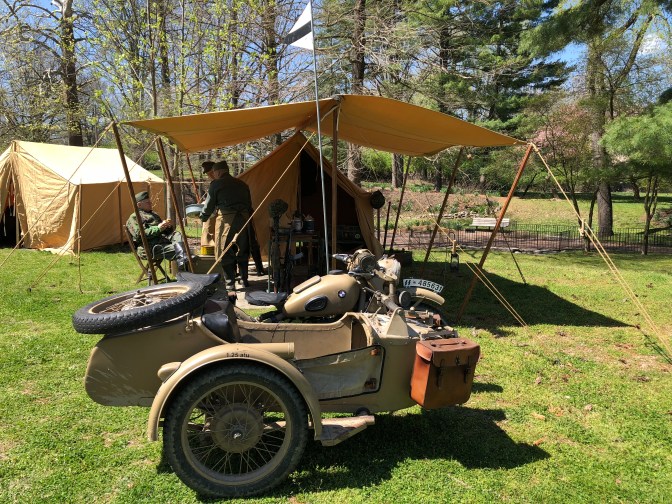
What the Italians lacked numerically, they made up for sartorially. While there were only a handful for them, they wore the most beautiful uniforms to be fielded in battle. Their tunics were tailored smartly, with stylish coloring and artistic design. Had it been possible to win a war with accessories, we would all be speaking Italian.
Ah, the French. There was no order to them. They wore no uniforms and they had no rank or hierarchy. Instead, they wore trench coats, pinstriped suits, and cordovan shoes. They roistered around between encampments but carried no weapons. Instead of rifles, they hefted bottles of wine, bread bags, and placards that derided the Boche. There was also no encampment of their own–no tents. I imagined they had some faux brothel into which they slinked during the later hours of the evening.
Approaching the Soviet camp, I was startled by a human skeleton (fake I assume) that was dressed in a Nazi uniform propped up at the gateway to the camp. A wooden sign hung around its neck that labeled the corpse “Fritz.” He was the grim mascot that reflected the depravity that resulted from siege.
The last encampment I visited was a group of German SS soldiers who were particularly well-outfitted. By far they had the finest quality equipment and the most orderly campsite. I also noticed that they were the only historical representatives with mounted cavalry—their horses pastured nearby. This deepened my interest immediately and I began inspecting the horse tack and other equine curios that they had on display. I asked several questions of the representatives that were standing by and they also seemed impressed by my curiosity. In return they asked me questions–Have I ever thought of reenacting? Would I like to participate? They explained that they were always looking for members with an interest in history and especially a background in equestrianism. Quite offhandedly I muttered something about not being eligible to be a Nazi and I noticed a sudden change in the tenor of my hosts. They didn’t need to say a word—their grimaced faces said it all—We aren’t actually Nazi’s, we are playing a role here. They might have also verbalized something to this effect, but I didn’t hear over the beaming and flush embarrassment upon my own face. Without thinking, my comments had just delivered the most undeservedly severe insult imaginable. I was horrified by my own indelicacy and I apologized and left quickly.
I planned to return to the camp the next day. In the morning, a large battle was scheduled, and it would be attended by all present nationalities. I looked forward to the spectacle of it. But I knew I must return with a different perspective and understanding that this was all, of course, theatre.
* * * * *
When I arrived back at the encampment the next day, I noticed a change in the overall demeanor of the living historians. The fraternization between allies and axis had ceased. Soldiers were moving about with urgency and purpose. They were checking weapons, handing out (blank) ammunition, tying boots, buckling straps, and so on. Soon, everyone would be heading out to the battlefield.
American troops began to gather in an open staging area away from the tents. They swaggered in from their enormous encampment with their rifles cradled in their arms like they were off to rabbit hunt. They wore their protective helmets raffishly cocked to the side, their rucksacks slung over one shoulder. Hand grenades hung casually from the straps on their uniforms. While they stood around talking, a small convoy of troop trucks rumbled into the staging area. One by one, the GI’s climbed into the backs or over the sides of the trucks. Their movements were informal and un-rushed. They helped boost one another up to the floorboards, then handed up their rifles. A few of the GI’s sitting in the trucks leaned over the sides and kissed the Clara Bow lips of sweethearts who wore flowered print dresses with their hair up in rolling waives and curls. The trucks popped their clutches and rumbled off down the path, sweethearts waiving and calling to their beaus.
 The German troops approached the staging area in lockstep formation, their jackboots pounding the path’s surface in bone chilling, precise unison. They lined up beside the path and stood at attention while their sinister looking halftracks roared to a halt. From attention, they snapped into choreographed and robotically efficient movements, climbing into the halftracks. They sat at perfect attention again, holding their rifles directly in front of them, their vacant eyes locked to the soldiers sitting across the aisle. They swayed only a bit as their vehicles lurched forward. Shouts brought the halftracks to an almost immediate halt, however. The Italian troops were running and gesticulating as they approached from the direction of their camp, their medals jangled, ribbons fluttered in the wind, their ornately decorated headgear nearly toppling from the tops of their heads.
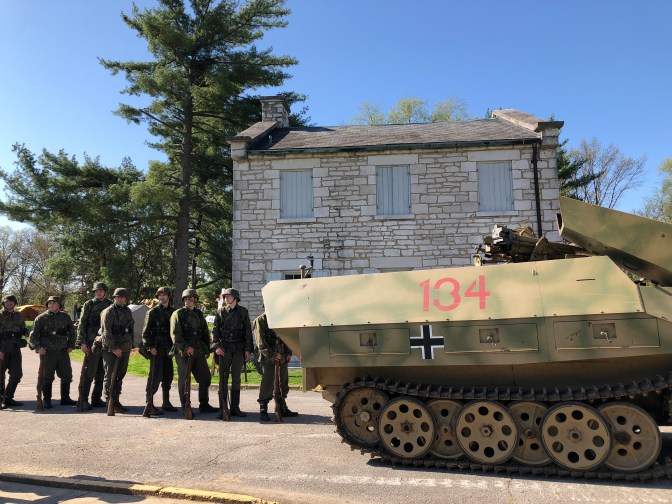
When they reached the back of the halftracks they clambered to get inside. The first heaved himself up and flopped to his belly onto the floorboards. The second heaved and did not make it, heaved again, and then reached up to be pulled up by his already boarded comrade. This went on a half a dozen times, and the whole time they did not stop chattering. They finally took seats next to their silent German allies. The large feathered plume jutting from an Italian’s hat tickled the cheek of a German soldier seated beside him—the German sighed and rolled his eyes.
The French troops were nowhere to be seen.
The Soviet troops marched through the staging area without stopping. They had no time to waste. They had some distance to travel, and had to do it on foot. They were followed by their unit’s one vehicle—a Ford Model A, painted in Soviet insignias, outfitted with a single machinegun, and laden with troops who hung from the running boards like a Tijuana Taxi.
I had the same distance to walk, and so I fell in behind the Soviet column. I noticed the disposition of their troops was decidedly more female than the others—which is incidentally not at all anachronistic. In fact, the Soviet army in WWII was comprised of a very large percentage of women. And like their historical counterparts, the women who marched in front of me wore the uniforms and carried the weapons of snipers. In the 1940’s, Soviet officers reckoned that women were more capable of patience, prolonged periods of discomfort, and vengeance. They were right. Thousands of women snipers held back the German invasion of Stalingrad and in a major way, defeated the Nazi menace one well-placed shot at a time.
I broke off from the Soviet column and made my way to the spectator area. There, a large crowd looked across a cordoned barrier to a large field with dense treelines to the left and right. In the middle lay faux architectural ruins, a few bunkers, and some pill-boxes. There were yet no troops to be seen, until a single mounted soldier—one of the SS cavalry—rode his horse alone out into the middle of the field. He was a screen, or patrol, meant to be the eyes of the larger force that followed him.
In the opposite treeline I noticed British troops who had been, heretofore, unseen. They were preparing to pounce on the German patrol—but in a “keep calm and carry on” fashion. Some of them sat astride idling armored cars futzing with their cravats and lighting pipes. Others stood by–mustachioed and bekilted, Enfields in hand. The British forces did not follow the same path or arrive in the same location as the rest of the allies. Monty. Typical.
The shooting began, and I cannot say who started it. In a few moments, the field was awash with rattling machineguns, cannon fire, rumbling tank tracks, and shouts–the din of which was surpassed only by a Briton blowing and banging away on his bagpipes.
As the battle raged on I thought about comments that people made to me when I explained what I would be watching this day. Some were curious. Some were uninterested. Many were dismissive and snarky—They’re grown men running around in period costumes. True. Similar to a baseball game or a church service, I suppose.
This battle, like all others, eventually ended–and in the end, the allies were left to gather the spoils, pick over the dead, and march off POW’s at gunpoint.
I left the battle with mixed feelings about the entire affair. Or maybe not mixed, but rather with complicated feelings. I reconsidered the question I had been asked the previous day by the German troops—would I reenact? It didn’t seem likely that I would. Was it simply that I would be discomforted by representing Nazi’s? That was part of it. But I suspect I would be similarly discomforted by the role should I play a Nazi in the legitimate theatre. I tried then to imagine myself portraying a more heroic role. Maybe a day-cravatted Briton with a swagger stick and bagpipe accompaniment. Or a Polish Uhlan mounting a cavalry charge against German armor. No, and no, I decided.
It isn’t that the pastime is beneath me. Nor do I find it the least bit offensive. But the reenactment lacked the parts of the story that I always find most compelling. Where were the starving civilian refugees? Where were the political prisoners? Where were the poor souls who dig the graves? Those are the stories that I want to learn. Besides all of this, I have never been one to be theatrical. Not intentionally, anyway.
While I don’t believe I could ever participate, I do appreciate the living historians. They live to preserve the details—the minutia of a soldier’s life. During World War II: How did an Italian soldier button his tunic? How did a German prepare his breakfast? How did a Soviet clean the rust from her weapon? These are questions that would be difficult to answer with a history book. But I am sure that these historians could explain—and with great detail. There is some value to that.
Looking back on my weekend observing living historians, war reenactors, or whatever we shall call them, it is clear to me that this is a pastime that has existed for time immemorial—and indeed has been a significant part of our culture…
* * * * * *
Excerpt from The Adventures of Tom Sawyer:
Tom skirted the block, and came round into a muddy alley that led by the back of his aunt’s cow-stable. He presently got safely beyond the reach of capture and punishment, and hastened toward the public square of the village, where two “military” companies of boys had met for conflict, according to previous appointment. Tom was General of one of these armies, Joe Harper, General of the other. These two great commanders did not condescend to fight in person — that being better suited to the still smaller fry — but sat together on an eminence and conducted the field operations by orders delivered through aides-de-camp. Tom’s army won a great victory, after a long and hard-fought battle. Then the dead were counted, prisoners exchanged, the terms of the next disagreement agreed upon, and the day for the necessary battle appointed; after which the armies fell into line and marched away, and Tom turned homeward alone.
~ Mark Twain


