
of a sports package by Bob Costas.
An unlikely resident of a Finnish mental institution often sat by himself in the hospital’s commissary. He wore thick coke-bottle glasses, an earnest and ever-present smile, and the musculature of a world-class athlete. Sitting and eating his breakfast, patients babbled either to him or through him, he was not sure. He could not speak Finnish, only English. He tried to be polite, nevertheless, because that was his way. Anyway, it was better than his small cell-bedroom. It was not padded, but it was cold and stark and windowless, except for the small peep-hole that looked inward rather than outward. The man was a plasterer by trade, and though he enjoyed his work, he thought constantly about flying. It was this fixation that placed him in this hospital, after all. He lived there until, one day, he received an unexpected and welcome reprieve. A letter from England that was addressed to him, and delivered to the directly to the hospital, carried a message that he had been waiting for for four years. In fact, it carried the greatest news of his life — ”…you are on the Olympic team.”
Michael Edwards had only been at the hospital for about a month — training with the Finnish ski-jumping team on the nearby facility. He stayed at the hospital not as a patient, but in return for laboring for his rent. He barely had any money and carried with him no sponsorship or team affiliation. He had been waiting for this glorious message ever since he, just barely, missed his chance at a spot on the British Downhill Ski Team during the 1984 Olympics. Michael was a world-ranked downhill skier–he was rated number nine in the world for speed skiing–reaching speeds faster than 106 mph. He also held a world record in stunt-jumping — soaring over ten cars, six buses. He was clearly a capable skier and daredevil. But record breaking was not his passion and danger was not his joy. In 1988, he cared only for one thing — representing his nation as an Olympian.
The heartbreak of being passed over for the 1984 Olympic team seemed to be too much for Michael. While he very nearly earned his spot as a down hill racer, he decided that he would change his focus and redirect his training to a discipline that was more likely to earn him his Olympic position. England, his homeland, had never qualified a ski-jumper for the international competition. He could ski, for sure. And certainly he had earned his in-flight credentials soaring over cars and buses. Olympic ski-jumping seemed only a short hop (the word play here being my own) from what he was already accustomed. He decided that he needed only formal training. He hadn’t much time to learn, but all the heart in the world.
Michael Edwards began his formal training with a sporting American gentleman in Lake Placid, NY named Chuck Berghorn. Berghorn took a personal interest in this pie-eyed athlete and went so far as to lend Edwards his personal equipment. Never mind that the boots ill-fit him, requiring him to wear several pair of extra socks. He trained relentlessly and made the most of the short time he had to learn. That time turned out to be just under two years of actual ski-jumping.
Olympic ski jumping was far different than anything he had attempted before. He was used to the fixed-heel ski bindings that were common in downhill skiing. Olympic ski-jumping was all-together different. The bindings are Nordic, or free-heel, meaning that the skier is attached only at the toes. As the skier descends down the very long slope of the jump, he leans forward, out over the tips of the skis, which are out over an interminable height above the ground below. Everything about this sport is contrary to human nature and self-preservation.
Nevertheless, Michael Edwards’ dream had come true. He was in Calgary, he was to compete as an Olympian, and he would represent his country.
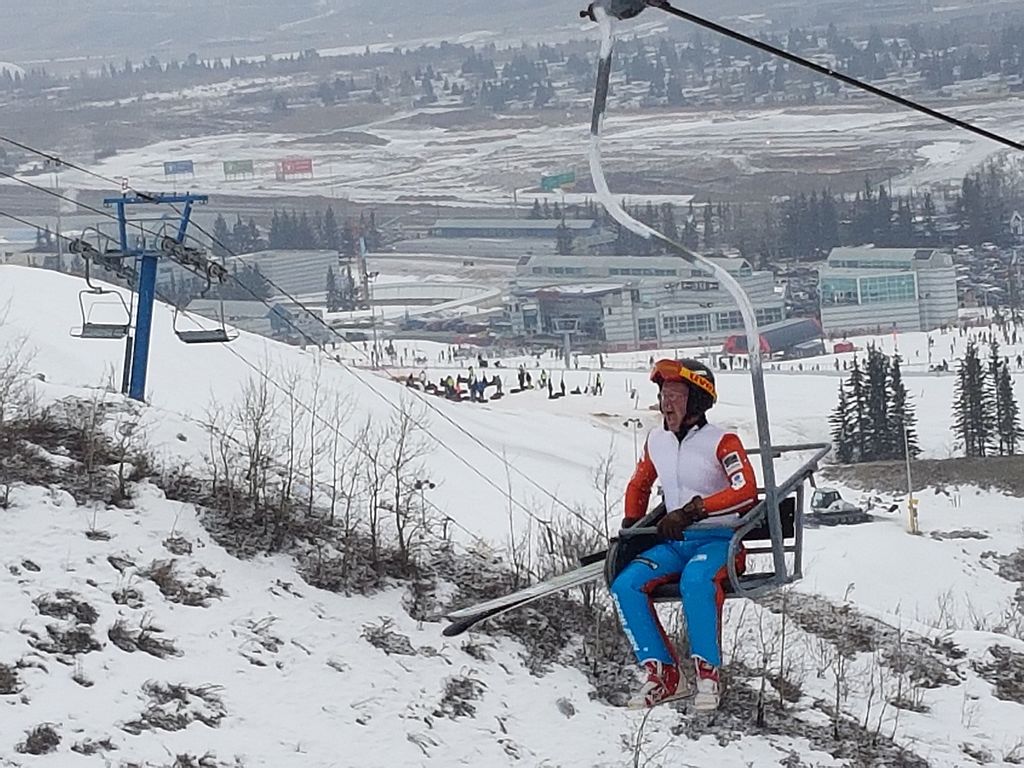
Just before his first jump of the games, Edwards seemed rattled and distracted. He was uneasy and fidgety while he took his place at the top of the sloping ski-jump. He wasn’t particularly nervous of the height–he was, by now, quite accustomed to the ramp he was about to descend. However, is thick glasses had begun to fog uncontrollably in the cold. He wiped at them constantly, but could achieve no clarity. He could not remove them completely, because of an exceptional farsightedness. He was nearly blind with few options. There was no turning back, however. There never was. He shoved himself down the slope and gained immediate speed. He teetered and swayed, and waived his arms for balance.
By this time the crowd watching-on had noticed Michael’s discomfort and lack of control. Onlookers held their breath and winced–would he lift off? Could he land? Would he live?
Michael’s skis reached the lip of the jump and he flew as he knew he could–though not very far. His skis flopped to the snow, well short of all other competitors for the day. However, he was right-side up. He glided to a stop and bent down to unbuckle his bindings with shaking hands.
People in the crowd gasped and exclaimed their concern–who was this person, and how did he get here? Did he know what he was doing?
Michael was dauntless and could not wait to jump again. It wasn’t a bad start for the first Englishman in history to ski-jump an Olympic event. Besides, somewhere, in another part of Calgary, Jamaicans were hurtling themselves down the icy halfpipe bobsled run. They haven’t any snow in Jamaica! It seemed, at this Olympics, anything was possible.
* * *
The Eagle Has Landed
During his first appearance as an Olympian, Michael Edwards made an indelible impression on the spectators of the 1988 Calgary Olympics. Unfortunately for him, it was not for the reasons he had hoped. His first jump was unstable and spastic and had caused a panic among the spectators. To those who watched, he seemed an unlikely participant and unsuited for the competition. True enough he landed safely on his first attempt–but the waiving of is hands and the instability of his legs worried on-lookers.
By the time Michael made his second ascent to the top of the enormous ski jump, the crowd was already aware of the reputation that now defined him. Sports commentators began assigning him demeaning nicknames:: Mr. Magoo, Ski Dropper, Falling Brick. As Michael attached his skis and faced down slope, spectators bustled and chatted nervously but excitedly — would he even make it this time? Possibly it was with a grim and morbid curiosity that some in the crowd began to take interest in Michael similar to those Nascar fans who watch in hopes of a terrible crash. He launched forth with an abandon that was similar to his first. Those spectators who were there to see a crash were, again, deprived. Edwards soared, however briefly, and landed safely on the ground. And the crowd, again, held their breath during his airborne moments, and then breathed with relief when he slowed to a stop.
Word rippled through the Olympic village about a fearless ski-jumper who competed with more heart than training. Rumors began to spread — A British ski-jumper who is afraid of heights! His first jump was during the Calgary games! He has no regard for his personal safety! All rumors were, of course, untrue. But his reputation was building cache, and his indomitable smile and ultra-thick glasses were endearing him to a public that loved underdogs. With every subsequent jump, larger crowds began looking forward to that name that now thrilled ski-jump enthusiasts:: Edwards. Never mind that his name was Michael, the crowds cheered and chanted for the jumper who was quickly becoming an Olympic favorite:: “Eddie… Eddie… Eddie!” As his supporters grew in numbers, the announcers changed their tone. Mr. Magoo was now Eddie the Eagle.
Eddie put on quite a show for his fans. He continued to teeter, sway, jump, and land—and the crowds exploded with cheers and applause every time he landed safely. And he landed safely every time.
During the closing ceremony, the president of the Olympic Committee announced “At this Games, some competitors have won gold, some have broken records, and some of you have even soared like an eagle.” Eddie the Eagle stole the show.
This pronouncement was too much for some, however. Shortly after, a barrage of complaints were levied by competitors, trainers, and teams — Eddie made a mockery of the games, some said, he had no right to compete with world class athletes, and worst of all, he got all the attention!
The International Olympic Committee responded to these complaints and established the Eddie the Eagle Rule, requiring athletes to rank in the top 30 percent or among the top 50 competitors in their sport. No longer would the Olympics tolerate participation for the sake of sportsmanship or patriotism. This new and ironically named rule became an unjust legacy for a gentleman who showed the world what can be right with sport and competition. Unfortunately, the Olympic Games were, from then on, concerned only with those who competed for gold.
All that glisters is not gold;
Often have you heard that told:
Many a man his life hath sold
But my outside to behold:
Gilded tombs do worms enfold.
Had you been as wise as bold,
Young in limbs, in judgement old
Your answer had not been inscroll’d
Fare you well, your suit is cold.
-William Shakespeare, The Merchant of Venice
* * *
For further reading on gentleman who compete against all odds, I recommend : Yes I can! : The Story of the Jamaican Bobsled Team by Devon Harris.

 Gentleman Afield
